
Searching Clay County Criminal Dockets
Know the court before you type a name. Clay felony dockets sit with Superior Court Clerk Patricia Thornton. Her office is Suite 3 in Fort Gaines. Georgia Courts lists Clay Superior in its E-Access directory. There is no anonymous statewide criminal search in Georgia that replaces the county route. Limited criminal and warrant matters can land in Magistrate Court. Fort Gaines city citations go the municipal route, and Juvenile matters carry special restrictions.
Enter the exact defendant name plus the case or indictment number when you have it. Jot down the court, the charge description, the filing date, and the newest setting. The Clay County case lookup route can help with the search sequence. When a result is missing, restricted, or needed as a certified copy, the clerk-confirmed record still counts.
- Identify Superior, Magistrate, Municipal, or Juvenile Court from the indictment, accusation, warrant, citation, or order.
- For Superior Court, open the Georgia E-Access directory and follow the Clay provider route. An account is required for the PeachCourt search layer.
- Search the exact criminal case number first. If it is unknown, use the defendant’s party name and check court, filing date, status, and judge.
- Open the case-information and docket layers. Review charges, proceedings, calendar events, pleas, disposition, sentence, and any document link.
- If the case does not appear, call the Superior Clerk or the lower-court office that owns the matter. Ask whether the file is older, juvenile, sealed, or held elsewhere.
Reading Clay Criminal Fields Under Rule 39.3
Uniform Superior Court Rule 39.3 gives you a field map. The map is for reading a Clay criminal docket. It covers a lot of ground. Charging document, defendant and counsel, offense classification, plea, proceeding history, disposition, sentence, warrants, appellate events, and final-record references all appear. Treat the rule as a schema, though. It is not a promise that every field will show up in an account-based public result. That risk grows when a provider shortens the labels.
- Indictment
- A grand-jury charging document identified in the criminal docket.
- Accusation
- A criminal charging document filed by the prosecuting authority rather than a grand jury.
- OBTS number
- The Offender Tracking Number that Rule 39.3 includes as a criminal docket field.
- Disposition
- The recorded result for a case or count, with its date and any related sentence entries.
- Remittitur
- The appellate return or mandate that sends a reviewed matter back to the trial court.
Clay publishes no complete local abbreviation list. Nor is there one universal year-prefix case-number format. Rely on the full label the clerk or provider displays. One code deserves a flag: GA030011J is the Georgia DDS reporting identifier for Fort Gaines Municipal Court, not an individual criminal case number.
Inside a Clay County Criminal Docket
A Clay County criminal docket opens with identity and charge information. From there it records what happened in court. Rule 39.3 calls for the fields above. PeachCourt's criminal support material may add more. A case status, assigned judge, co-defendants, attorneys, charges, calendar events, proceedings, disposition, and documents can all show up there. Keep one distinction in mind. A docket line is never the same as the document behind that line.
| Case or indictment number | The unique number for the criminal action or charging instrument. |
|---|---|
| Filing date | The date the clerk records the indictment or accusation. |
| Defendant and OBTS | The defendant name and Offender Tracking Number referenced by Rule 39.3. |
| Defense attorney | The attorney of record, when the docket or provider displays counsel. |
| Offense counts | Each charge, felony or misdemeanor classification, and traffic citation number when applicable. |
| Final-disposition judge | The judge associated with the final disposition or other recorded proceeding. |
| Plea and plea date | The response entered for each count, such as guilty, not guilty, or nolo contendere, with the date. |
| Trial type | Whether a jury or bench trial occurred, if the field applies. |
| Disposition | The result for each count and its date, such as dismissal, nolle prosequi, verdict, or plea outcome. |
| Proceedings | Dates and types for arraignment, pretrial, motion, plea, trial, sentencing, review, or other settings. |
| Sentence | Sentence date and type, term, conditions, costs, fines, and restitution when recorded. |
| Warrant entries | Bench-warrant date and officer return, plus judgment-absolute or scire-facias entries when applicable. |
| Appeal history | Transcript filing, sentence-review application, notice of appeal, remittitur, and related dates. |
| Final record reference | Minutes, final-record page, storage area, or box cross-reference used by the clerk. |
Find the newest dated event first. That tells you where the case stands. A status of "Disposed" means the case or count has an outcome, nothing more. It does not say whether that outcome was a dismissal, plea, conviction, acquittal, or something else, so read the exact entry and its date.
PeachCourt Clay Criminal Search Gate
PeachCourt is the mandatory Superior e-filing connection for Clay. The Georgia Courts E-Access directory lists Clay Superior. The e-filing matrix marks the provider route as mandatory. Its public search path runs through an account. Registration asks for a name, email, password, secret question and answer, a reCAPTCHA, and agreement to the terms. Support instructions describe picking a county and court. You then search by exact case number or party name. A case page can lead to "View Case Docket". There it can show docket proceedings or documents as available.
The account gate matters twice over. First, there is no way to test an anonymous Clay criminal name search from the search shell. Second, document access is a separate transaction. Current terms describe an eAccess charge of $2.00 per document. Pages cost $0.50 each, plus a 3.5% and $0.30 convenience fee per transaction. A party or eFiler may get no-charge access to its own eFiled documents. Manual or criminal documents can follow different charges. The clerk remains the official custodian either way.
The PeachCourt landing page shows the civil and criminal provider shell used for the Superior route.
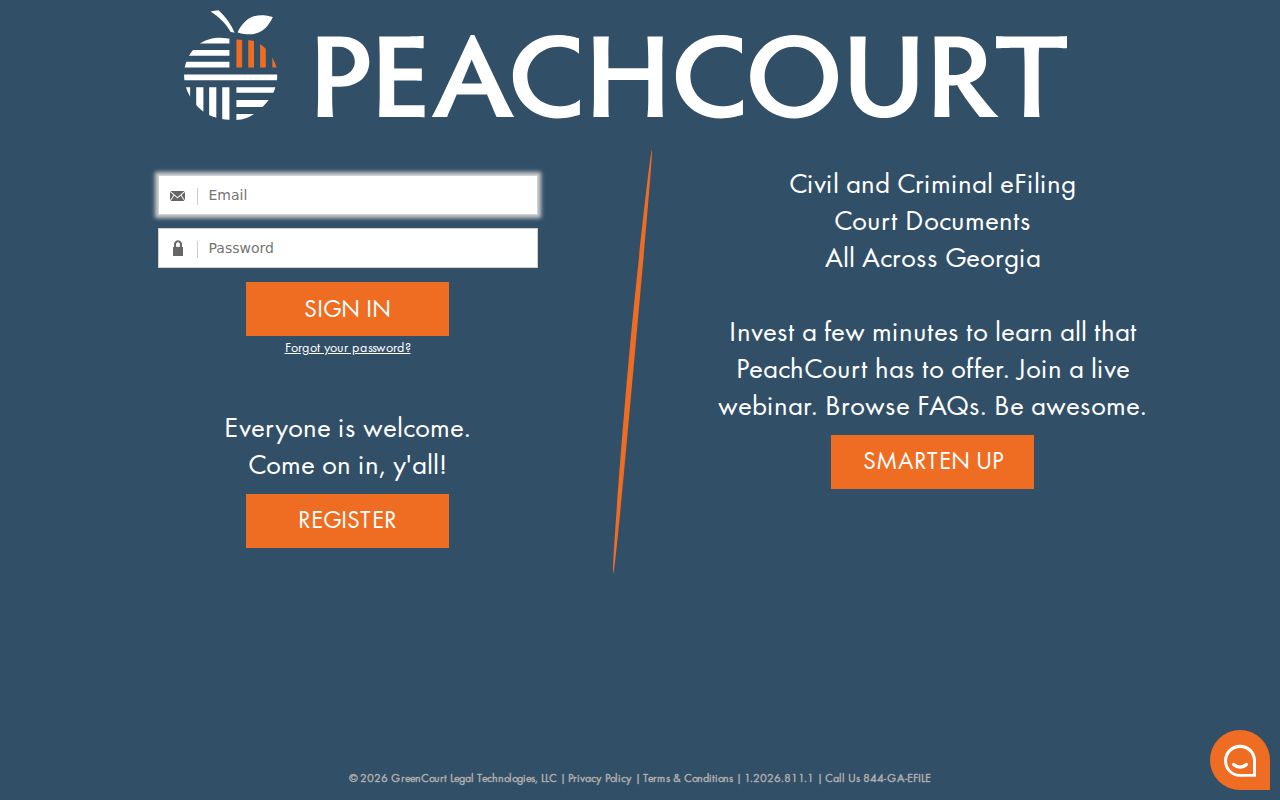
Remember what the provider shell is. It is an access layer, not a substitute for a clerk-certified criminal docket or a court order.
| Search control | What it does | Access note |
|---|---|---|
| County selector | Limits the provider search to the selected county | Clay option is reached through the account-based provider |
| Court selector | Chooses the court holding the case | Exact public dropdown options were not exposed without login |
| Case number | Searches an exact criminal action or indictment number | Use the clerk-supplied format |
| Party name | Searches a defendant or other party name | Confirm court, filing date, and case status |
| View Case Docket | Opens the case-information and docket layer | Document images may be separately billed or excluded |
How a Criminal Case Moves
A criminal docket is a sequence, not one label. The charging document opens the case. Arraignment or a plea entry records the defendant's response. Bond, warrant, pretrial, motion, and calendar entries fill the space between filing and a final result, and a trial or negotiated plea then produces the disposition, followed by sentencing or another closing event. An appeal can add transcript, notice, remittitur, and return entries on top.
Criminal docket flow: Indictment or accusation › arraignment or plea › bond and settings › pretrial or motions › plea or trial › disposition › sentence › appeal or remittitur.
Bond and bench-warrant entries need date context. A warrant issue never states how the case ended. A later return does not replace the disposition. A sentence entry can spell out term, conditions, costs, fines, or restitution. When a case holds more than one offense, read the count-level outcomes.
Patricia Thornton’s Clay Criminal Counter
When a PeachCourt result is absent or incomplete, go to the Superior Clerk. That office is the criminal-record fallback for Clay County. Patricia Thornton's office sits at 210 Washington Street South, Suite 3, Fort Gaines, GA 39851. Call (229) 768-2631 or fax (229) 768-3047. The Georgia Superior Court Clerks' Cooperative Authority lists public hours of 8:00 a.m.-4:30 p.m., Monday through Friday. The same listing notes the office stays open during lunch. Give the clerk the case number and defendant name. Add the court, charge if known, and the particular entry or document you need.
The GSCCCA profile for Clay's clerk confirms the office, phone, and Superior/Juvenile coverage.
Superior Court Clerk
210 Washington Street South, Suite 3
Fort Gaines, GA 39851
(229) 768-2631
Superior and Juvenile clerk records
Need an older Clay County paper file, a certified copy, or a straight answer on access? Walk up to the counter. That is often the fastest route. A phone call works too. It can tell you whether a matter sits with Superior, Juvenile, Magistrate, Probate, or a city court before you drive over. Mail is fine when the clerk explains the copy process and how to pay. The office publishes no public-terminal count. It posts no general turnaround promise and no full Superior certified-copy fee schedule. If you file a written Open Records request, name the exact record. Name the office that holds it too. A vague request for a criminal-history bundle will not get you far.
Courts That Hold Criminal Dockets
Different courts, different dockets. Felonies in Clay County go to Superior Court. Magistrate Court takes warrants, preliminary hearings, minor offenses, and county ordinance work within its authority. Fort Gaines Municipal Court covers city traffic and ordinance citations. Juvenile Court handles delinquency and dependency, though juvenile records are not a normal adult criminal search. Current official directories list no separate Clay State Court.
| Court | Criminal matter | Custodian or contact |
|---|---|---|
| Superior Court | Felony indictments and accusations, pleas, trials, sentences, and appeals | Superior Clerk, Suite 3, (229) 768-2631 |
| Juvenile Court | Delinquency and child-related cases with special restriction rules | Superior Clerk/Juvenile structure; ask before requesting access |
| Magistrate Court | Warrants, preliminary hearings, minor offenses, and county ordinance matters | Suite 5, (229) 768-2841 |
| Fort Gaines Municipal Court | City traffic and ordinance citations | City Hall, (229) 768-2443 |
Start with the court named on the charging paper. A search that stops at PeachCourt can miss a Magistrate warrant. It can also miss a Fort Gaines citation or a juvenile matter. The offices sit close together, but their dockets are not combined. The county Magistrate Court page is the official source for lower-court jurisdiction. It is also the route to that office.
Pataula Drug Court and Clay Criminal Dockets
The Pataula Circuit Drug Court is an adult accountability-court program serving seven counties: Clay, Early, Miller, Quitman, Randolph, Seminole, and Terrell. It began in May 2001. Its public profile names Judges T. Craig Earnest and Henry Balkcom, coordinator Beau Leyse, and phone (229) 424-8295. The Council of Accountability Court Judges profile supplies the service area and public program contact. No participant-level docket or public case list is published. So look for program events on the underlying Superior criminal case. A referral, compliance hearing, graduation, or termination may appear as an entry or order under that case number. Search the case number first. Treatment and program details are not a separate public docket.
Sealed Dockets and Public Access
Superior criminal records start open under Rule 21. Sealed filings, protected identifiers, adoption material, and juvenile records carry extra limits. Rule 21.6 requires a redacted public version before an unredacted filing goes under seal. The public provider may exclude sealed, adoption, and proposed unexecuted documents. A disposed case is not sealed automatically. A missing document image says nothing about the legal result.
Access points:
Superior Rules 21 and 21.6 set the public-record baseline and the redacted-versus-sealed filing process.
Uniform Magistrate Court Rule 20 limits displayed Social Security, taxpayer, and financial-account identifiers to the last four digits and the year of birth.
Georgia Courts Juvenile and restriction guidance explains that Juvenile and restricted records follow special routes.
O.C.G.A. § 35-3-37 governs a criminal-history restriction process; it does not automatically delete the court’s docket.
A result marked sealed, restricted, or juvenile should push you back to the basics. Keep the public case number, the status, and the date. Ask the Superior Clerk whether a redacted docket or access order can be viewed. For a history-record restriction, use the prosecutor or GBI route as the official process directs. Keep that question apart from the court-file request. Rules also shift over time. The fields and filing controls in a Clay County case can change while an older case stays in the system. The Georgia Supreme Court's 2026 administrative-order page records dated statewide amendments. They include a new Superior Rule 36.19 effective February 26, 2026, plus other amendments with later effective dates. The Supreme Court administrative-order list is the source for the dated rule-update record. Trust the current Georgia rules. Do that when a clerk or provider label differs from an older printout.
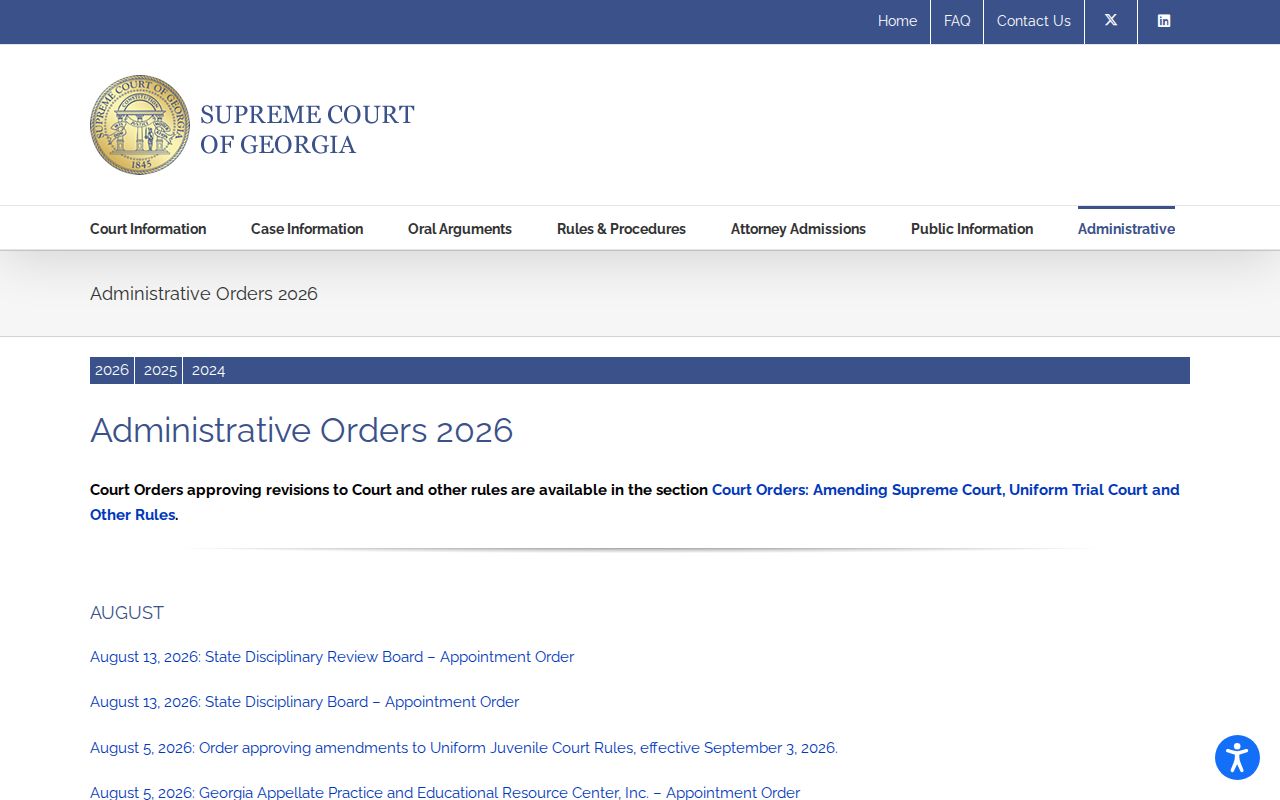
That rule-update record is statewide, not a Clay portal release. It is a reason to check the current rule text before relying on an older docket instruction or access summary.
Clay and Columbus Criminal Dockets Compared
A federal criminal matter tied to Clay County does not land on the Superior docket. It belongs to the U.S. District Court for the Middle District of Georgia, Columbus Division. The federal courthouse sits at 120 12th Street, Columbus, Georgia 31902, phone (706) 649-7816. Federal access runs through PACER, backed by CM/ECF. PACER charges $0.10 per page. It generally caps a document or report at $3.00, and it waives charges of $30 or less per quarterly cycle. Viewing at the courthouse is free. CourtListener/RECAP offers free copies of some federal filings. But the federal clerk and PACER remain the official route. The Middle District Columbus office page is the official federal location source. PACER pricing supplies the access terms.
| State criminal docket | Federal criminal docket |
|---|---|
| Clay Superior Court and Superior Clerk | Middle District of Georgia, Columbus Division |
| PeachCourt account layer plus clerk fallback | CM/ECF filing system plus PACER access |
| Georgia Rule 39.3 field structure | Federal numbered docket entries and document links |
| County clerk controls certified state copies | Federal District Clerk controls certified federal copies |