
Searching the Clay County Court Docket
Clay County has no single anonymous search box that reaches every court. So route your docket search by court first. Superior Court holds felonies, major civil cases, domestic-relations matters, and many Juvenile clerk records. Probate handles estates, guardianships, vital records, and county traffic. Magistrate takes smaller civil claims, warrants, garnishments, dispossessory matters, and preliminary work. Fort Gaines Municipal Court keeps city traffic and ordinance cases. A Superior case search usually runs through the Georgia Courts E-Access directory and its account-based provider. Lower-court matters start with the clerk's office.
Bring the exact party name. Also bring the action or case number, the court type, and the filing year if known. Include any date printed on a citation or order. The code GA030011J identifies Fort Gaines Municipal Court for state reporting; it is not a case number for one person's file. Does a name search turn up unclear results? Weigh the court, the filing date, the case status, and the newest event together. The Clay County case lookup explains the search mechanics. The clerk's office still issues any certified copy.
- Identify the court named on the filing, citation, or order. Do not send a Superior matter to Probate or a Fort Gaines city citation to the county traffic counter.
- For a Superior matter, open the Georgia E-Access directory, choose the Clay Superior route, and sign in or register with the provider when the search requires an account.
- Search by the exact case number when it is known. Otherwise use the party name and confirm the court, filing date, case style, and status.
- Read the case-information and docket layers together. Check the newest proceeding, setting, order, disposition, and any document link.
- If the result is missing, restricted, older, or incomplete, call the correct clerk or visit the matching suite. Ask for a plain, certified, or electronic copy by name.
Clay County Docket Search in PeachCourt
Georgia Courts lists Clay Superior in its E-Access directory. It is not a second statewide database. The directory points to an account-based provider. The state e-filing matrix makes PeachCourt mandatory for Clay Superior, so PeachCourt is the closest public online layer for Superior case and document activity. An account does not blur the line. A docket entry, a document image, and a certified clerk copy stay three different things.
The provider's support pages describe a county selector, a court selector, a case-number search, and a party-name search. A returned case may show the assigned judge, status, co-defendants, and attorneys. Charges may be listed. Calendar events, docket proceedings, disposition, and available documents may also appear. The full Clay court dropdown sits behind a login. If a search fails, use the exact values the clerk supplies, and never read an empty result as proof that no court record exists.
Two official pages document the mandatory connection: the Georgia Courts E-Access directory and the Georgia Courts e-filing matrix. They explain where the provider fits. They do not make PeachCourt the official record keeper for Clay County court records.
Inside a Clay County Court Docket
A Clay County docket is a dated register of case activity. The Superior civil and criminal rules give detailed field maps. PeachCourt may show only a subset. Its case-information page decides what appears. The first screen can identify the court, the action number, the parties, and the status. From there the register supplies filings, proceedings, settings, orders, disposition, appeal steps, and storage references. A document icon may point to an image. But opening that image can require a separate account transaction.
| Action or case number | The clerk-assigned identifier for a civil action, criminal indictment or accusation, or other court matter. Clay’s public pages do not publish a universal number-format guide. |
|---|---|
| Court and judge | The court of record and the judge assigned or shown for final disposition, trial, or a proceeding. |
| Parties and attorneys | Plaintiff, defendant, petitioner, respondent, the State in a criminal matter, and attorneys of record when the provider displays them. |
| Filing and service | Opening date, filing activity, costs, service date and type, and a second-original destination in a civil case. |
| Charge or cause | Criminal counts with classification and citation details, or the civil cause of action and case style. |
| Docket entries | A chronological list of pleadings, motions, notices, hearings, orders, pleas, judgments, warrants, appeals, and other recorded events. |
| Settings | The event date, proceeding type, and any courtroom, judge, or calendar details supplied by the court or provider. |
| Disposition and money | Judgment, dismissal, plea, verdict, settlement, sentence, costs, fines, restitution, Fi. Fa., or other outcome fields when recorded. |
| Appeal and storage | Notice of appeal, remittitur, minutes or final-record reference, and an off-site storage or box cross-reference when the rule requires it. |
| Redaction or restriction | Sealed entries, juvenile material, adoption material, and protected identifiers may be hidden or shown only in a redacted form. |
Remember that the docket is the index, not the whole file. A complaint, motion, signed order, judgment, or transcript is a separate record. A plain download is not automatically certified. The clerk's office decides what can be copied, certified, or inspected. The governing rule applies. So does any sealing order.
Clay County Docket Counters in Fort Gaines
The physical route is compact but split across suites at 210 Washington Street. Superior Court Clerk records and the filing counter sit in Suite 3. Probate is in Suite 1. Magistrate is in Suite 5. The Superior courtroom has its own address at 145 Wilson Street, so confirm the hearing location rather than assuming the records counter and the courtroom share a door.
The county's office directory lays out this three-counter arrangement. It does not publish a count or feature list for public-access terminals, a records annex, parking rules, or Clay-specific device and security procedures. Before you drive over, ask the right office. Ask whether a public terminal or paper file is available. The Clay County office directory supplies the source context for the routing cards that follow.
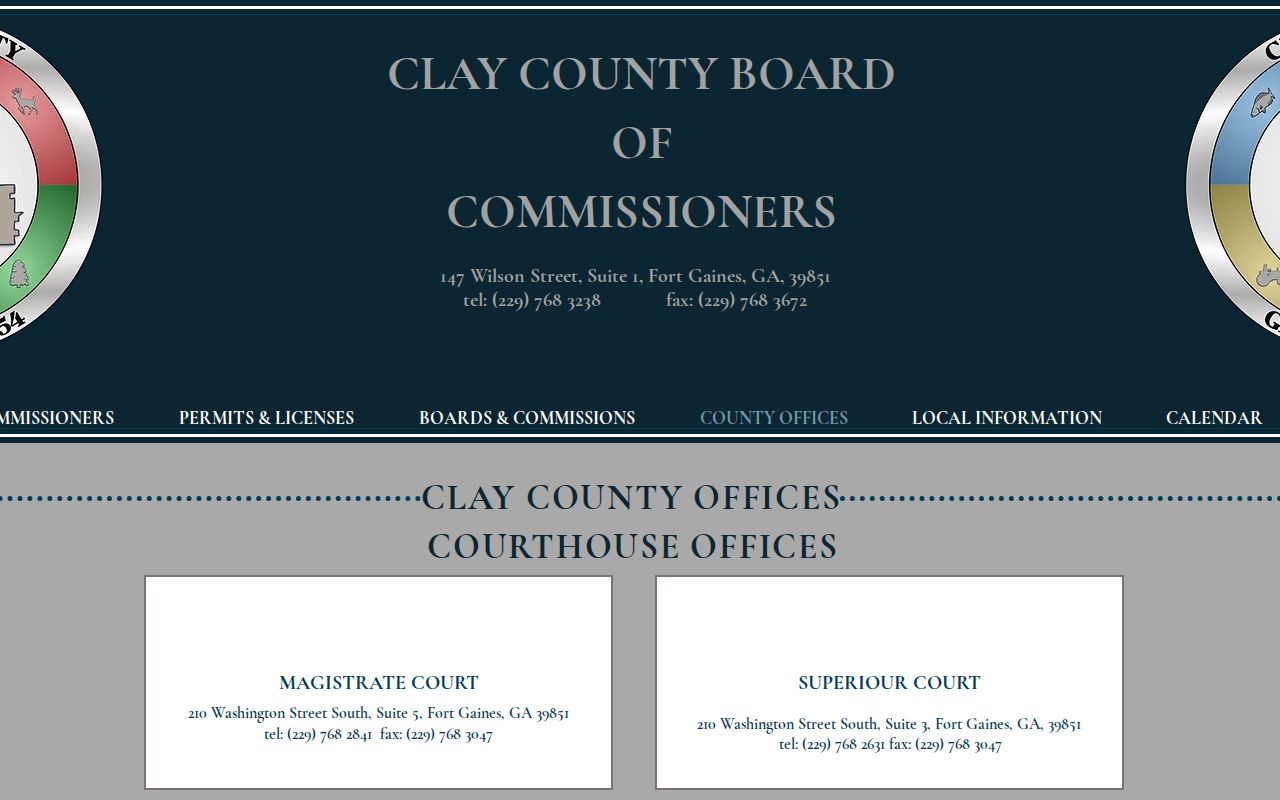
The county's office-level split shows in that official page. Suite choice is part of the docket search, not a small detail, because each Clay County office keeps a different slice of the public record.
Superior Court Clerk
210 Washington Street South, Suite 3
Fort Gaines, GA 39851
(229) 768-2631
8:00 a.m.-4:30 p.m., Monday-Friday
Probate Court
210 Washington Street, Suite 1
Fort Gaines, GA 39851
(229) 768-2445
Traffic and probate records
Magistrate Court
210 Washington Street South, Suite 5
Fort Gaines, GA 39851
(229) 768-2841
8:00 a.m.-4:30 p.m., Monday-Friday
The Clay County Magistrate Court page shows the lower-court jurisdiction and the filing route that belongs in Suite 5.
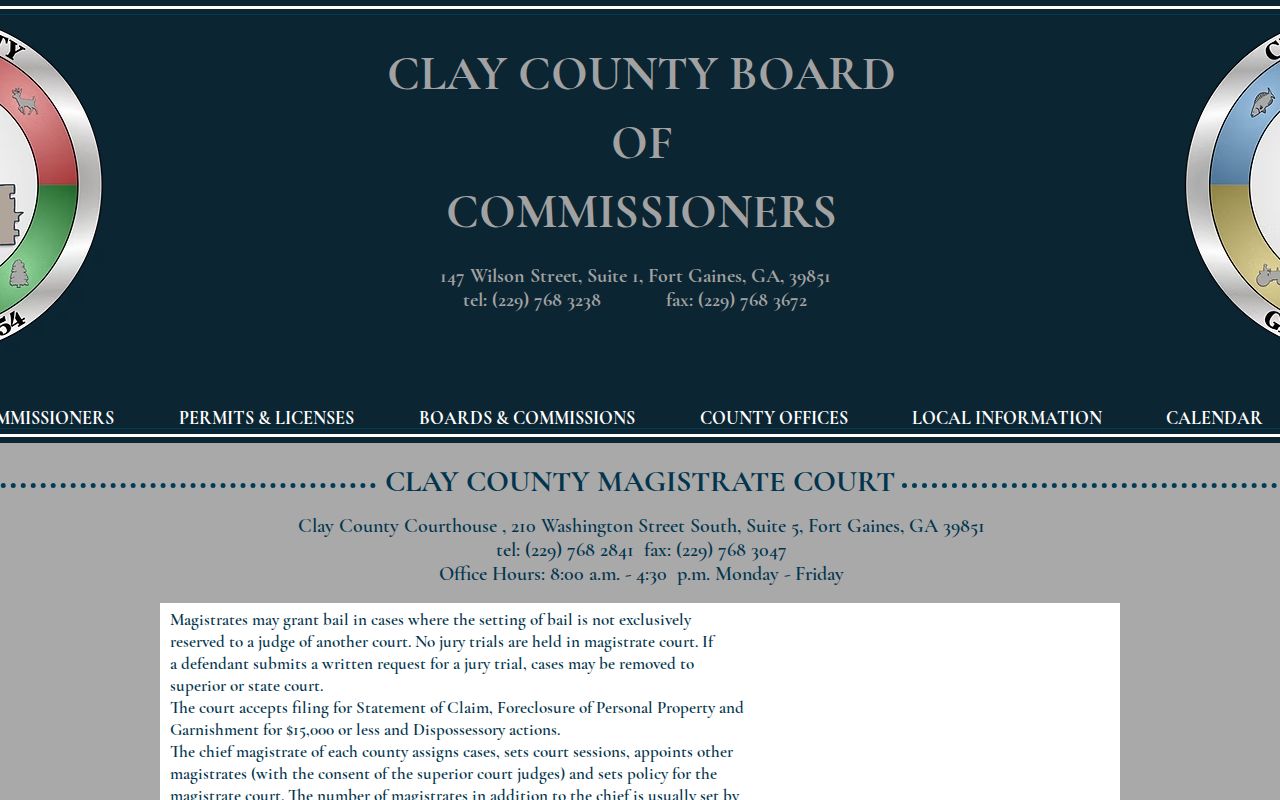
The Magistrate page is a useful reminder. Smaller civil and warrant dockets carry their own forms, fees, and keeper.
Courts That Keep Dockets in Clay County
Georgia's court hierarchy matters here. The phrase "court record" can point to different keepers. Superior Court is the general-jurisdiction trial court for felony criminal, major civil, and domestic-relations matters. Juvenile Court handles delinquency and dependency cases. Clerk functions route through the Superior structure. Probate and Magistrate share a practical office relationship. They keep different docket types. Fort Gaines Municipal Court is a city route. No separate Clay State Court appears in the current county, clerk, or Pataula directories.
| Court | Docket covers | Where to search |
|---|---|---|
| Superior Court of Clay County | Felonies, major civil actions, divorce, domestic relations, real estate, and appeals or corrections from limited courts | Superior Clerk, Suite 3, or the Clay Superior PeachCourt route |
| Juvenile Court | Delinquency, dependency, and child-related matters with added access limits | Superior Clerk/Juvenile structure; ask before requesting a file |
| Probate Court | Estates, wills, guardianships, vital records, licenses, and county traffic citations | Probate Court, Suite 1 |
| Magistrate Court | Civil claims up to $15,000, garnishments, dispossessory matters, warrants, preliminary hearings, and minor offenses | Magistrate Court, Suite 5 |
| Fort Gaines Municipal Court | City traffic and ordinance citations | Fort Gaines City Hall or the municipal court route |
The Court of Appeals of Georgia is the first review court for many appeals, and the Supreme Court of Georgia hears constitutional and other exclusive appellate matters. An appeal creates new docket activity, but the original Clay County record does not vanish. Start with the underlying court, then confirm the appellate path. The Clay County Probate Court page supplies the county traffic and probate counter route.
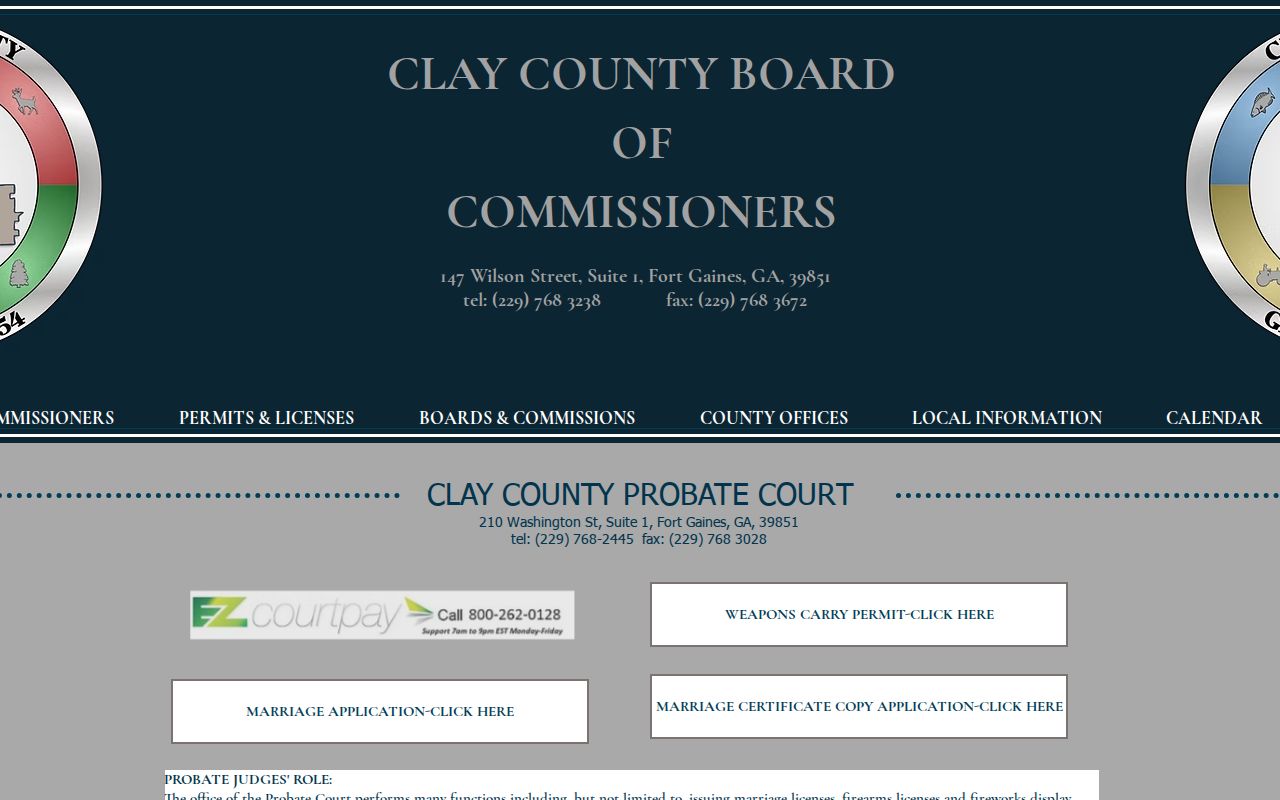
Probate's separate role matters. It keeps county traffic, estates, and vital-record questions from being folded into the Superior criminal or civil search.
Clay County Docket Routes by Court
Clay County is small, with a 2020 Census population of 2,848. Its court records still split across several desks, though. A docket search can lead to Superior, Juvenile, Probate, or Magistrate court, plus municipal matters. Fort Gaines, the county seat, hosts the office cluster where most filings start.
The old courthouse adds character. Built in 1871-1873, it sits on the National Register. The Georgia Department of Community Affairs notes its vernacular and Greek Revival style. Charm does not decide where a case lookup goes, though. Suite locations do.
The Clay County government page lays out the local administrative setting that follows.
That small footprint is exactly why a court-first search beats a broad name search here. The offices sit within easy walking distance of one another, yet their dockets never merge.
The newest Superior workload numbers cover the region, not the county by itself. The Pataula Judicial Circuit spans seven counties. Its 2025 assessment reports two Superior judges, 1,461 cases per judge, 1,529 criminal defendants in the three-year average, and 1,432 civil matters over that same stretch. Treat those figures as circuit-wide scale. None of them counts Clay County filings. Still, they give a fair sense of the load. The judges carrying the Clay County docket face that load each year.
The 2025 Pataula workload assessment is where that regional caveat comes from.
How to Find Court Dates and Settings
A court date can surface in several places. A citation may carry one, or a case docket may log it. A circuit calendar may list it, and a clerk or judge can confirm it. For the paper trail, the case docket wins. It stands as the best lasting record of a notice, an order, a continuance, or a final disposition. A calendar only suggests scheduling and cannot promise that every Clay setting appears there. Before you rely on a date, read the newest docket entry. Then confirm with whichever office controls that court.
Date check: Citation or order › newest docket setting › circuit calendar if applicable › clerk or judge confirmation. Payment before a Probate traffic arraignment may avoid appearance, but payment on the scheduled arraignment date still requires appearance. Contesting a citation requires appearing and entering not guilty. The full Clay County Court Dates route explains the calendar controls and reset problem.
The Clay Superior Court page posts the clerk's public hours, the FANS link, and the business the Superior bench handles.
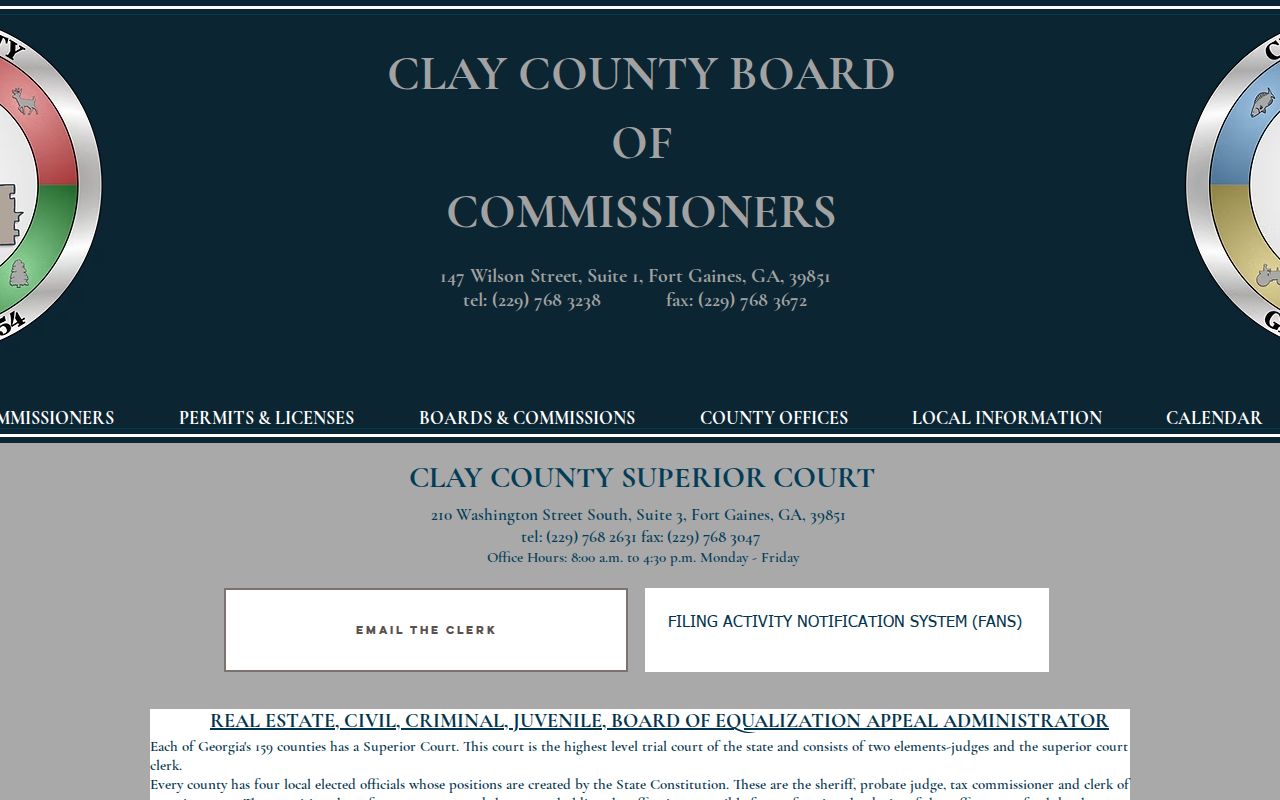
One page, two different questions. A calendar inquiry and a records request can land with the same clerk yet call for separate answers.
Clay County Court Calendar Search Limits
The Pataula circuit calendar runs on a public Keep&Share interface with day, week, month, year, event, tag, and timeline views. You also get text search, date ranges, event notes, overlays, tags, print, and export options. What the public view does not give is a Clay-specific event. Remember that gap. A calendar with no matching entry does not prove a case has no setting, so treat it as one channel rather than the final word.
The Pataula schedule page explains how the public may observe and asks anyone watching a video proceeding to contact the judge's office at least 24 hours ahead. From there, confirm by court. Superior case? Call the Superior Clerk. Probate traffic goes to the Probate office. Magistrate matters go to Suite 5. A Fort Gaines citation belongs on the city route. Emergency orders can shift deadlines too, so when a posted date clashes with a later notice, check with the local court.
The Pataula public calendar works as a scheduling aid, never as a substitute for a Clay docket or certified confirmation from the clerk.
| Channel | Useful for | Limit |
|---|---|---|
| Case docket | Recorded notices, settings, orders, and reset history | May require an account or omit lower-court cases |
| Pataula calendar | Published circuit schedule and exportable date views | Inspected view had no Clay event and is not the full docket |
| Clerk or judge office | Current setting, courtroom, remote link, or reset confirmation | Office-specific; use the court’s own phone |
| Citation or order | Initial traffic appearance or written setting | May be superseded by a later order |
Public Access to Court Dockets
Georgia leans toward public access. That baseline still bends to court rules, sealing orders, juvenile law, and redaction duties. An Open Records request fits an administrative county record or a file that never appears online, but it will not convert every court record into a free statewide result. Send the request to the office that actually holds the docket. When a filing contains protected material, ask for a redacted public version.
Key rules:
O.C.G.A. §§ 50-18-70 through 50-18-72 establish Georgia’s open-government policy, inspection and copying rights, and exemptions.
Uniform Superior Court Rule 21 treats Superior court records as public unless access is limited by law or procedure.
Uniform Superior Court Rule 21.6 calls for a redacted public filing before an unredacted protected version is submitted under seal.
Uniform Magistrate Court Rule 20 limits displayed identifiers to the last four digits and the year of birth, with the filing party responsible for redaction.
Not everything files as an ordinary public document. Sealed, adoption, juvenile, and some restricted criminal-history material often stays out of view. A missing image could reflect a provider exclusion, a sealed filing, an older file, or a docket held by a different clerk. Ask the clerk which access category applies. Do not read a legal outcome into an absent result.
Clay County FANS and Docket Searches
FANS stands for Filing Activity Notification System. Clay's Superior Court page links it as a filing-alert option. A matched alert means filing activity may have occurred, nothing more. It is not a full case-information page. It is not a public calendar. It is not a certified docket. For the whole event history, use the Superior search route or ask Patricia Thornton's office.
Quick distinction: FANS alerts about filing activity. PeachCourt supplies the account-based Superior case and document layer. The Superior Clerk keeps the official record. Those three functions should not be treated as interchangeable.
The alert-versus-docket line matters most when an alert arrives with no clear setting. It matters too when a case search shows an event but no image. Keep the alert details, then verify the case number, filing date, and document type with the clerk or provider.
Docket Records at the Clerk's Office
Patricia Thornton serves as the elected Clay County Clerk of Superior Court. That is per the Georgia Superior Court Clerks' Cooperative Authority. Her office keeps Superior and Juvenile clerk records. That covers felony criminal, civil, domestic-relations, real-estate, and Juvenile material, all subject to access rules. You can find the office at 210 Washington Street South, Suite 3, Fort Gaines, Georgia 39851. Phone (229) 768-2631. Fax (229) 768-3047. The public window runs 8:00 a.m.-4:30 p.m., Monday through Friday. The GSCCCA profile notes the office stays open through lunch. The GSCCCA clerk profile gives the official word on the office and its court coverage.
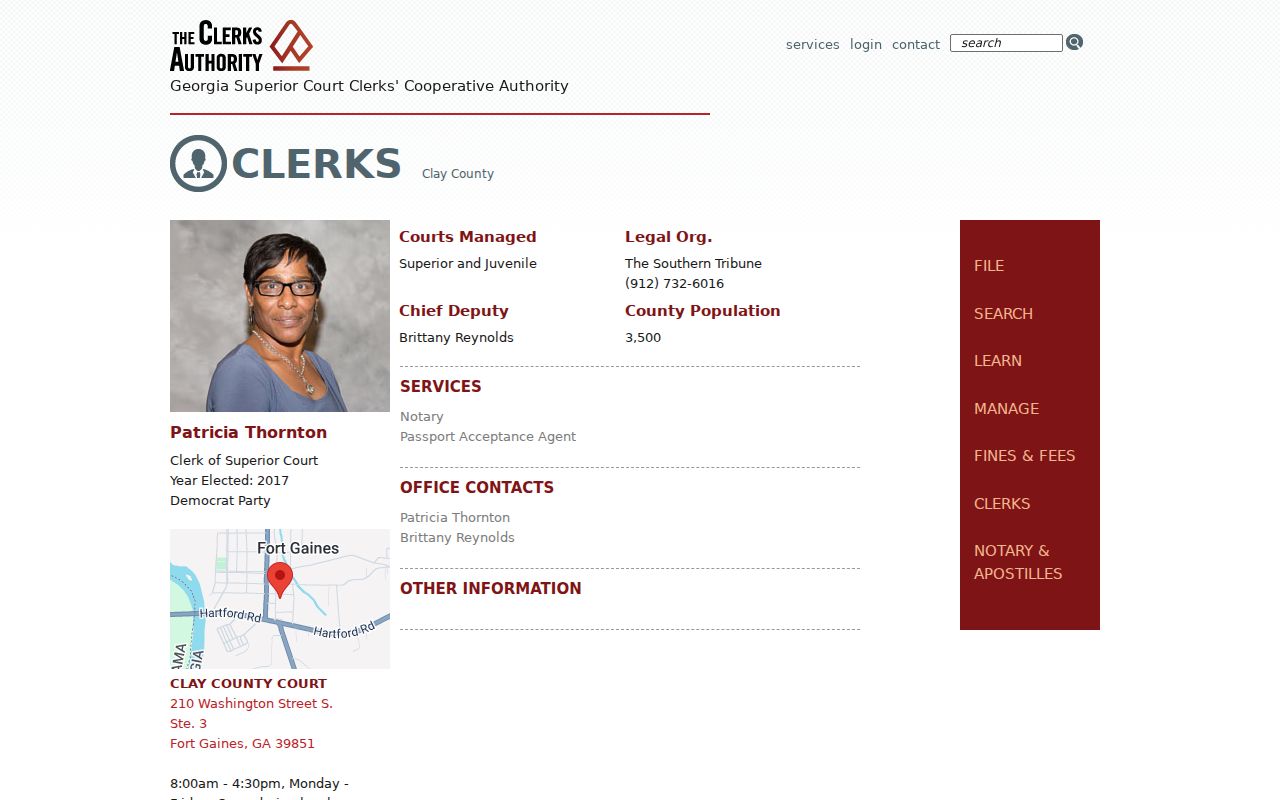
An online docket search sometimes comes back thin. Go straight to the clerk instead. The office holding the Clay County Superior or Juvenile record can explain the allowed copy or inspection route. Ask about fees too. The current county Superior page posts no complete schedule of certified-copy charges. Confirm the amount for a plain, certified, or exemplified copy before mailing payment. PeachCourt's current terms list $2.00 per eAccess document. The terms add $0.50 per page, and a 3.5% plus $0.30 convenience fee per transaction. Those are provider charges, not proof of a certified clerk copy.
| Record route | Published amount or status |
|---|---|
| PeachCourt eAccess document | $2.00 per document |
| PeachCourt document image | $0.50 per page |
| PeachCourt transaction | 3.5% plus $0.30 convenience fee |
| Superior plain, certified, or exemplified copy | Current Clay amount not located; confirm with Thornton’s office |
| Magistrate Statement of Claim | $100.00 for one defendant, $50.00 each additional defendant |
| Magistrate Fi. Fa. | $29.00, including Superior recording costs |
When a Clay County file is old or missing, give the clerk the court, case number, party names, record type, and approximate filing date. Details speed up the docket search. A written Open Records request should identify the custodian and the record sought. The clerk posts no public-terminal count, turnaround promise, or county-wide drop-box rule. Confirm those details with the office directly.
Clay County Docket Access and Redaction
Public access has limits in Clay County. Rule 21 sets the baseline for Superior access. Rule 21.6 covers protected identifiers and sealed filings. Juvenile and adoption records carry special restrictions of their own. Probate law adds that a will filed for safekeeping is not a public record. Under Rule 20, Magistrate filings should show only the last four digits of a Social Security, taxpayer, or financial account number. Those filings should also show the year of birth. A clerk may keep the full file. The public view may show nothing more than a redacted docket or event line.
- Public docket
- The accessible index of case events, settings, and outcomes, subject to lawful limits.
- Restricted record
- A file or data category whose access is limited by statute, rule, or court order.
- Redacted copy
- A public version with protected identifiers or confidential portions removed.
- Sealed filing
- A document submitted under a court-approved access limitation rather than ordinary public inspection.
- Certified copy
- A clerk-authenticated copy issued through the custodian’s process, not an automatic feature of an online image.
Restricting a criminal history is one process. Deleting a court docket is another. A person may need to contact the prosecutor or the Georgia Bureau of Investigation about the history record and the Clay County clerk about the underlying file. Never treat "disposed," "closed," or a missing image as a synonym for sealed.
Clay County Drug Court Docket
Drug cases in Clay County run through the Pataula Circuit Drug Court, an accountability-court program. It serves Clay, Early, Miller, Quitman, Randolph, Seminole, and Terrell counties. The program began in May 2001. The Council of Accountability Court Judges profile lists the public contacts. Its judges are T. Craig Earnest and Henry Balkcom. Beau Leyse coordinates the program. The phone number is (229) 424-8295. No participant-level docket, case list, or program-length schedule appears on the public profile. A referral, compliance hearing, graduation, or termination may still show up in the underlying Superior criminal case. It appears there as an event or order. That case number is the better search anchor for a docket lookup.
Clay County Court Dockets by City
Clay County has fewer than five incorporated cities. Fort Gaines ranks first in the 2020 Census table with 995 residents. Bluffton is second with 113. City cases don't all go to the county clerk. Fort Gaines runs its own municipal traffic and ordinance route, while Bluffton posts no official municipal docket portal. County traffic, Magistrate matters, and Superior matters still follow their county court custodians, and the Census incorporated-place table is the source for the population vintage and ranking.
Fort Gaines Docket Search
2020 Census 995; municipal route, no public docket viewer found.
Bluffton Docket Search
2020 Census 113; no official municipal docket portal located.
Start with the city name printed on the citation. A Fort Gaines city citation should be confirmed through the city route. Confirm before routing a Bluffton matter to Fort Gaines Municipal Court. Check the paper with care. If it points to county traffic, use Probate and EZ Court Pay. If it names Magistrate or Superior, use that clerk's suite instead.
Map and Directions to the Clay County Courthouse
Superior and Juvenile clerk records are kept in Suite 3 of the county office building at 210 Washington Street South, Fort Gaines, which also holds Probate in Suite 1 and Magistrate in Suite 5. The Superior Court's actual courtroom, however, is a separate address at 145 Wilson Street, so confirm with the Superior Clerk whether a scheduled hearing is at the courtroom or the records counter before traveling.
Superior Court Clerk, Suite 3
210 Washington Street South
Fort Gaines, GA 39851
(229) 768-2631
8:00 a.m.-4:30 p.m., Monday-Friday
No reviewed official source publishes a public-terminal count, parking rule, or Clay-specific security procedure for either building, so call (229) 768-2631 before a trip. The 1871-1873 courthouse carries National Register status with vernacular and Greek Revival influence, but current suite locations, not historic character, control where a request begins.